The Numbers That Matter
These are the four that govern how you feel on TRT and how safely you're running it. Everything else in the panel supports these.
The Essential TRT Panel
Run these at baseline before your first injection. Every 90 days once stable. Sooner if you change dose or ester.
| Marker | Why It Matters | Target | Frequency |
|---|---|---|---|
| Total Testosterone | Hormone level including ester-bound T | 600–1,000 ng/dL | Every 90 days |
| Free Testosterone | Bioavailable fraction — what cells actually use | 15–25 pg/mL | Every 90 days |
| Estradiol (sensitive assay) | Aromatase conversion — drives mood, libido, water retention | 20–40 pg/mL | Every 90 days |
| Hematocrit | RBC density — rises on TRT, thrombosis risk above 52% | Below 52% | Every 90 days |
| Hemoglobin | Oxygen-carrying capacity — tracks with hematocrit | Below 17.5 g/dL | Every 90 days |
| PSA | Prostate-specific antigen — baseline required before TRT | Below 4.0 ng/mL | Annually (men 40+) |
| LH / FSH | Pituitary signals — expected to suppress on exogenous T | Near zero on TRT | Baseline only |
| CBC | Complete blood count — includes hematocrit and hemoglobin | Normal ranges | Every 90 days |
| CMP | Metabolic panel — kidney and liver function | Normal ranges | Every 90 days |
| SHBG | Binds testosterone — high SHBG reduces Free T | 20–50 nmol/L | Baseline, then annually |
Target ranges vary by individual and lab. Work with your prescribing physician on your specific targets — these are widely-used clinical reference points, not universal standards.
When to Test
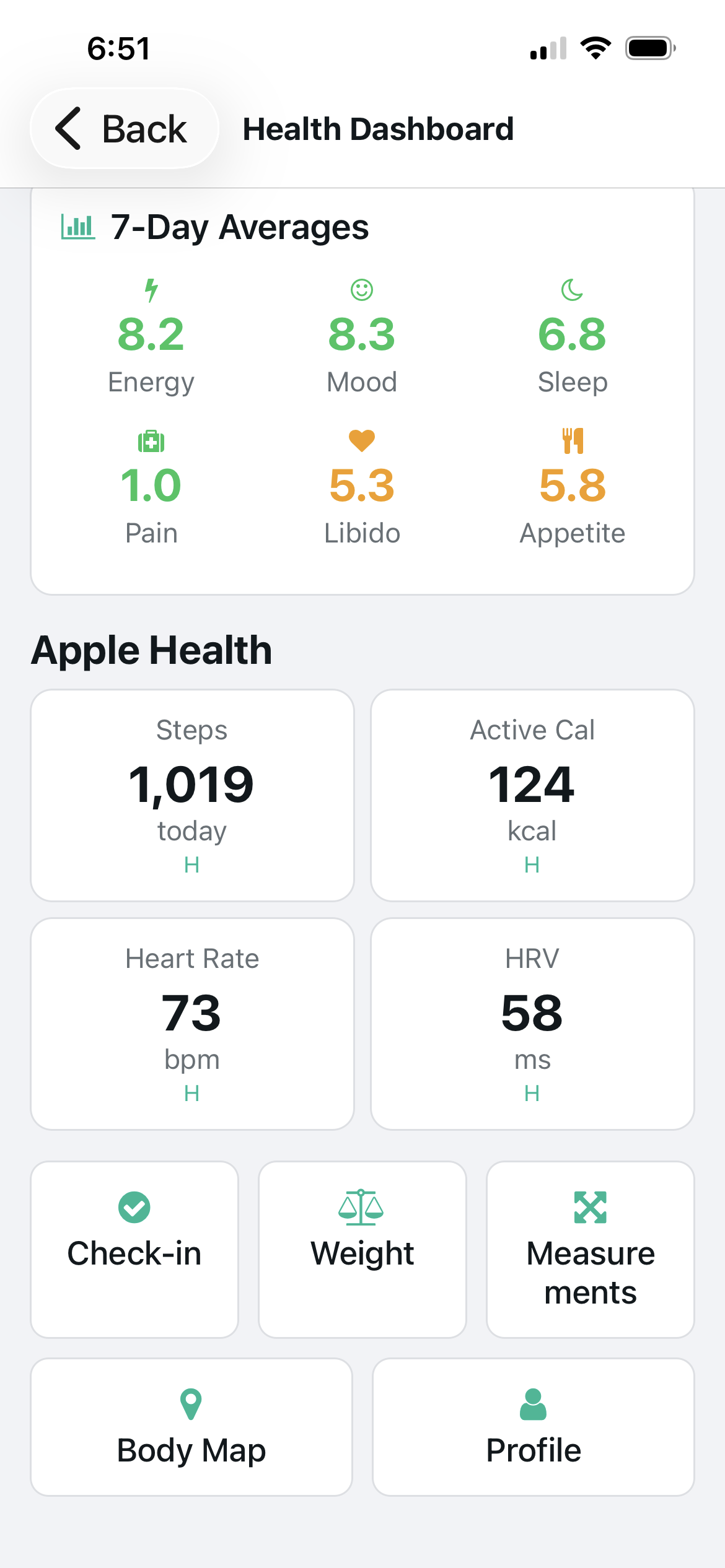
Protocol logs labs with your protocol context — one view of dose history and bloodwork over time
Run the full panel. This establishes pre-TRT values for Total T, Free T, Estradiol, PSA, Hematocrit, and SHBG. PSA baseline is critical before starting — a pre-existing elevation found before TRT avoids a difficult clinical conversation later.
Testosterone Cypionate has a ~8-day half-life. Stable levels take 5–6 half-lives, or 40–48 days. Testing before 4-6 weeks post-change gives you a mid-transition result — not the actual steady state. Wait the full cycle before adjusting.
Quarterly testing catches hematocrit creep — the most common TRT safety issue — and gives you trend data across Total T, Free T, and Estradiol relative to how you feel. Stable labs over multiple draws are evidence your protocol is working.
Estradiol — Track the Trend, Not the Number
Testosterone converts to Estradiol via aromatase. On TRT, Estradiol rises — this is expected. The question is whether it rises into a range that produces symptoms for you specifically.
Most men feel well between 20–40 pg/mL on the sensitive assay (not the standard immunoassay — the sensitive assay is more accurate for men at lower E2 levels). Below 20 often produces low libido, joint pain, and mood issues. Above 50 tends to produce water retention and emotional lability.
Starting an aromatase inhibitor before you have a symptomatic high E2 AND a lab value confirming it is not good clinical practice. Many men on TRT never need an AI. Track symptoms alongside labs across at least two draws before intervening.
Hematocrit — The One That Can Hurt You
TRT stimulates erythropoiesis. Over months, hematocrit rises. Most clinicians consider above 52–54% a threshold for intervention. Above 55–56% is a meaningful thrombosis risk. This is the one marker that requires you to take action, not just monitor.
Options: dose reduction, more frequent smaller injections (reduces peak-to-trough variation), or therapeutic phlebotomy. Blood donation is practical and benefits someone else. Catch the trend early — address it before it becomes an emergency.
Free T vs Total T
Total T measures all testosterone including what's bound to SHBG and albumin. Only Free T — roughly 2–3% of Total T — is bioavailable. A man with 800 ng/dL Total T and high SHBG may have less usable testosterone than a man at 600 ng/dL with low SHBG.
If your Total T looks good but you still feel suboptimal, check Free T and SHBG. The combination of the three tells you where the constraint is.
What blood tests are needed for TRT?
How often do I need bloodwork on TRT?
What happens if hematocrit gets too high on TRT?
Track Your TRT Bloodwork in Protocol
Log labs with your protocol context. See trends over time. iOS + Android.


No account required · On-device only · Free
Also see: Testosterone ester calculator → · TRT tracker guide → · trttracker.org →